.png)
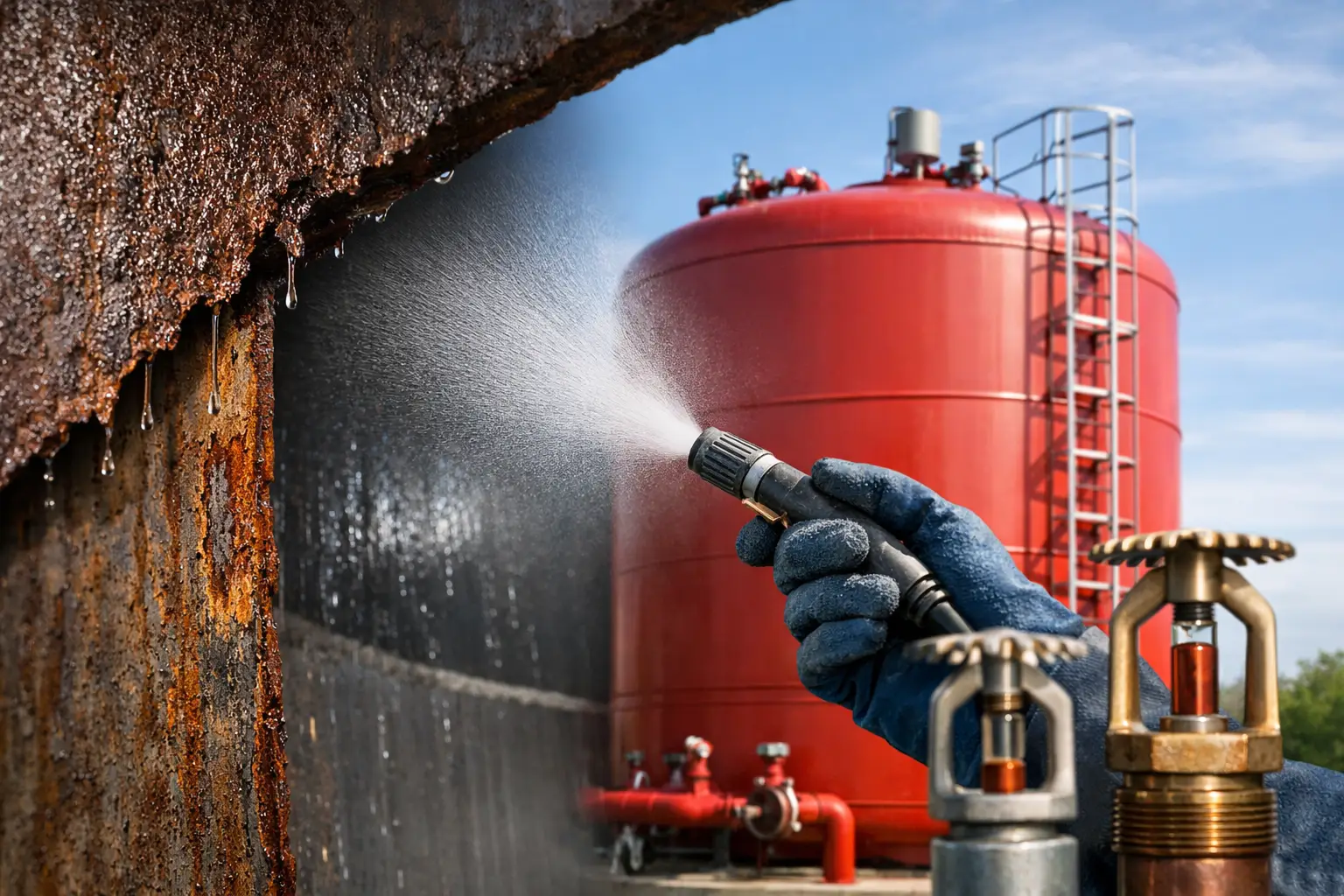
Best Ways to Stop Corrosion in Sprinkler Tanks
A small area of rust at a tank seam can be the visible sign of a much wider problem. Once corrosion reaches the steel substrate, fixings, roof supports or internal joints of a sprinkler tank, it can compromise watertightness, reduce structural strength and create unwelcome questions during an insurer inspection. The best ways to stop corrosion are therefore not limited to applying a coating over damaged metal. They begin with a clear diagnosis, then combine suitable repair methods, effective protection and planned inspection.
For fire water storage, the objective is not simply to make a tank look better. It is to preserve a reliable, compliant water supply for the sprinkler system while avoiding avoidable disruption and premature replacement.
Why sprinkler tanks corrode
Corrosion occurs when steel reacts with water and oxygen, but the conditions within and around a sprinkler tank determine how quickly that reaction progresses. Standing water, fluctuating water levels, condensation beneath a roof, failed protective coatings and poor drainage can all accelerate deterioration. At joints and fasteners, trapped moisture may produce localised corrosion that is more serious than a broad area of superficial rust.
External corrosion deserves equal attention. Damaged cladding, leaking roof sheets, failed gutters, deteriorated purlins and inadequate ventilation allow rainwater or condensation to remain in contact with structural components. In sectional galvanised steel tanks, loss of galvanising at edges, bolt holes and damaged panels can leave the underlying steel exposed.
The first practical point is that corrosion rarely has one cause. A coating failure may be the visible issue, while movement at a joint, roof leakage or an unsuitable previous repair is allowing moisture to return. Treating only the symptom leads to repeated maintenance expenditure.
Best ways to stop corrosion before it spreads
Start with a specialist condition survey
A detailed survey establishes where corrosion is present, how deep it extends and whether it is affecting the tank's structure, lining or ancillary components. This is the stage where a repair can be separated from a replacement decision on evidence rather than assumption.
The survey should assess internal surfaces, sectional joints, bolts, base and wall interfaces, roof structure, access points, overflows and pipe penetrations. It should also consider the condition of any existing liner or coating. Blistering, cracking, lifting edges and discolouration can indicate that moisture has travelled beneath the protective layer.
Where draining the tank would disrupt fire protection or site operations, a remotely operated vehicle inspection can provide valuable internal evidence without taking the water supply out of service. It will not replace every intrusive investigation, but it can identify lining damage, sediment, corrosion hotspots and areas requiring targeted follow-up. This makes maintenance planning more proportionate and reduces unnecessary downtime.
Remove the cause, not only the rust
Loose corrosion products, failed coating material and contaminated surfaces must be properly prepared before any protective system is installed. The preparation method depends on the substrate, access constraints and repair specification, but the principle remains the same: a new coating or repair material cannot perform reliably on an unstable surface.
Just as importantly, the route by which water reaches the affected area must be addressed. A roof leak, blocked gutter, damaged flashing or failed seal at a penetration can defeat an otherwise sound refurbishment. If internal corrosion is associated with a damaged liner, local patching may be appropriate for isolated defects, but widespread deterioration usually calls for a more comprehensive lining solution.
This is where technical judgement matters. Aggressive surface preparation may be unsuitable where the tank's remaining thickness is limited, while a cosmetic overcoat can conceal active corrosion without restoring protection. The correct scope should reflect the condition of the asset, not a one-size-fits-all product choice.
Specify the right protective system
Protective linings and coatings are central to corrosion control, but they serve different purposes. An internal EPDM lining creates a durable barrier between stored water and the tank structure. It can be particularly effective when an ageing steel tank remains structurally viable but its existing internal protection has failed. By separating the water from the steel, a correctly installed liner can significantly extend service life and help prevent further internal corrosion.
Epoxy coating systems can provide a hard, protective finish where substrate preparation and environmental conditions allow. They are often considered for internal or external areas, depending on the approved system and the particular tank construction. Their success depends heavily on preparation, specified film thickness, curing conditions and careful treatment of edges, seams and details.
For localised structural issues, fibreglass repairs may restore integrity to suitable GRP components or address specific defects. Corroded steel sections, however, may require panel repairs, replacement sections or reinforcement following engineering assessment. No lining or coating should be treated as a substitute for resolving a structural weakness.
Protect vulnerable roofs, joints and access areas
Tank roofs are often overlooked because attention naturally falls on the water-retaining shell. Yet roof corrosion can introduce contaminated rainwater, create falling-object risks and eventually affect the integrity of purlins, supports and access arrangements. Replacing degraded roof sheets and purlins, repairing guttering and maintaining effective weather protection are direct corrosion-control measures.
Sectional joints require particular care. Ageing sealants, corroded bolts and movement between panels can allow moisture ingress and lead to leakage. During refurbishment, joints should be assessed as a system rather than as isolated lines on a drawing. Compatible seals, fixings and lining details are essential where tank movement and hydrostatic pressure are present.
Low-level access housing also supports better long-term condition management. Safer access makes routine checks more likely to happen and reduces the temptation to defer inspection until a leak or insurer concern forces action. In a safety-critical asset, maintainability is part of corrosion prevention.
Control the environment around the tank
Even the best refurbishment will have a shorter life if the surrounding environment is ignored. Keep roof drainage clear, prevent vegetation from retaining moisture against tank walls and investigate persistent condensation. Check that overflow and warning pipe arrangements are operating as intended, since recurring discharge can keep external areas wet and mask a developing defect.
Water quality, sediment accumulation and periods of low turnover may also influence internal conditions. The appropriate response will depend on the tank design, water source and fire system requirements. Any cleaning or treatment proposal must be compatible with the sprinkler installation and should not introduce a risk to the stored fire water supply.
For sites close to the coast, in heavily polluted industrial environments or exposed locations, inspection intervals may need to be more frequent. Corrosion rates are not uniform across the UK, and an approach that is adequate for a sheltered inland plant room may be insufficient for an exposed external tank.
Build corrosion checks into planned maintenance
Corrosion control is most cost-effective when defects are found while repair remains targeted. Planned inspections should record coating condition, visible rusting, leaks, joint movement, roof and gutter condition, liner performance and any changes since the previous visit. Good records help demonstrate responsible asset management to insurers, auditors and internal stakeholders.
The frequency and depth of inspection should reflect the tank's age, construction, environment, previous defects and the requirements governing the sprinkler installation. A tank with known historic leakage or a deteriorating roof should not be managed on the same interval as a recently installed, well-protected asset.
When remedial work is recommended, prioritise issues that threaten water retention, structural safety or sprinkler availability. Cosmetic corrosion can wait only where a competent survey confirms that it is genuinely superficial and the protective system remains sound. Delaying action on active corrosion often turns a manageable refurbishment into a larger capital project.
Refurbishment versus replacement
Full replacement is sometimes necessary, particularly where there is extensive structural loss, severe distortion, repeated failure or a tank that no longer meets operational requirements. However, replacement is not automatically the best response to corrosion. It can involve significant cost, programme implications and disruption to a site's fire protection arrangements.
Where the structure is serviceable, refurbishment can offer a commercially sensible route to a longer asset life. A combination of repair, roof works, new lining, coating and improved access can address the causes of deterioration while retaining much of the existing tank. The decision should be based on a surveyed condition, lifecycle cost and the practical need to maintain dependable sprinkler water storage throughout the works.
A corrosion problem is an opportunity to establish the true condition of a critical asset before a minor defect becomes an emergency. Nationwide Water Solutions Ltd approaches this work through technical assessment and targeted remediation, helping responsible persons protect the tank, the fire water supply and the budget allocated to it. The most effective next step is a specialist inspection that identifies what needs attention now and what can be planned with confidence.


Comments