
How to Repair Tank Seams in Sprinkler Tanks
A leaking seam is rarely just a local maintenance issue. In a fire sprinkler tank, it can indicate deterioration in joint sealant, corrosion around panel connections, movement within the structure or failure of an existing lining. Understanding how to repair tank seams begins with identifying the cause, not simply applying a sealant to the visible leak.
For duty holders, facilities managers and fire protection contractors, the priority is to restore the tank’s integrity without compromising available fire water, regulatory obligations or the long-term condition of the asset. The right repair can extend service life substantially. The wrong one may conceal ongoing corrosion and lead to a larger, more disruptive failure later.
How to repair tank seams: assess the failure first
Tank seams occur where sectional steel or GRP panels meet, and their condition depends on the original tank design, construction materials, age and operating environment. Bolted sectional tanks commonly rely on gaskets or sealants compressed between panels. Over time, these components can harden, creep, crack or lose compression. External weathering, internal water exposure, poor historic repairs and differential settlement can all contribute.
A visible drip at a seam does not necessarily show the true source of the problem. Water can track behind panels, through deteriorated gasket material or from a higher joint before emerging elsewhere. On lined tanks, the leak may also be associated with damage to the liner rather than the steel or GRP seam itself.
A competent survey should establish whether the issue is isolated or widespread. This includes examining the affected seam, surrounding panels, bolts, flange details, tank base, roof condition and supporting structure. Evidence of corrosion, distorted panels, loose fixings, failed mastic or water staining should be recorded. If internal access is restricted because the tank must remain in service, a remotely operated vehicle inspection can provide valuable information without draining the tank.
The survey should also consider the tank’s fire protection role. Repair planning needs to account for the required water volume, sprinkler system impairment procedures, insurer requirements and any applicable standards or site-specific fire risk controls. A repair that is technically possible may not be operationally acceptable if it leaves the property without adequate fire water protection.
Identify the seam repair method
There is no single repair method for every tank seam. The appropriate approach depends on the tank material, the scale of deterioration and whether the tank can be isolated, partially emptied or taken out of service.
Resealing an accessible external joint
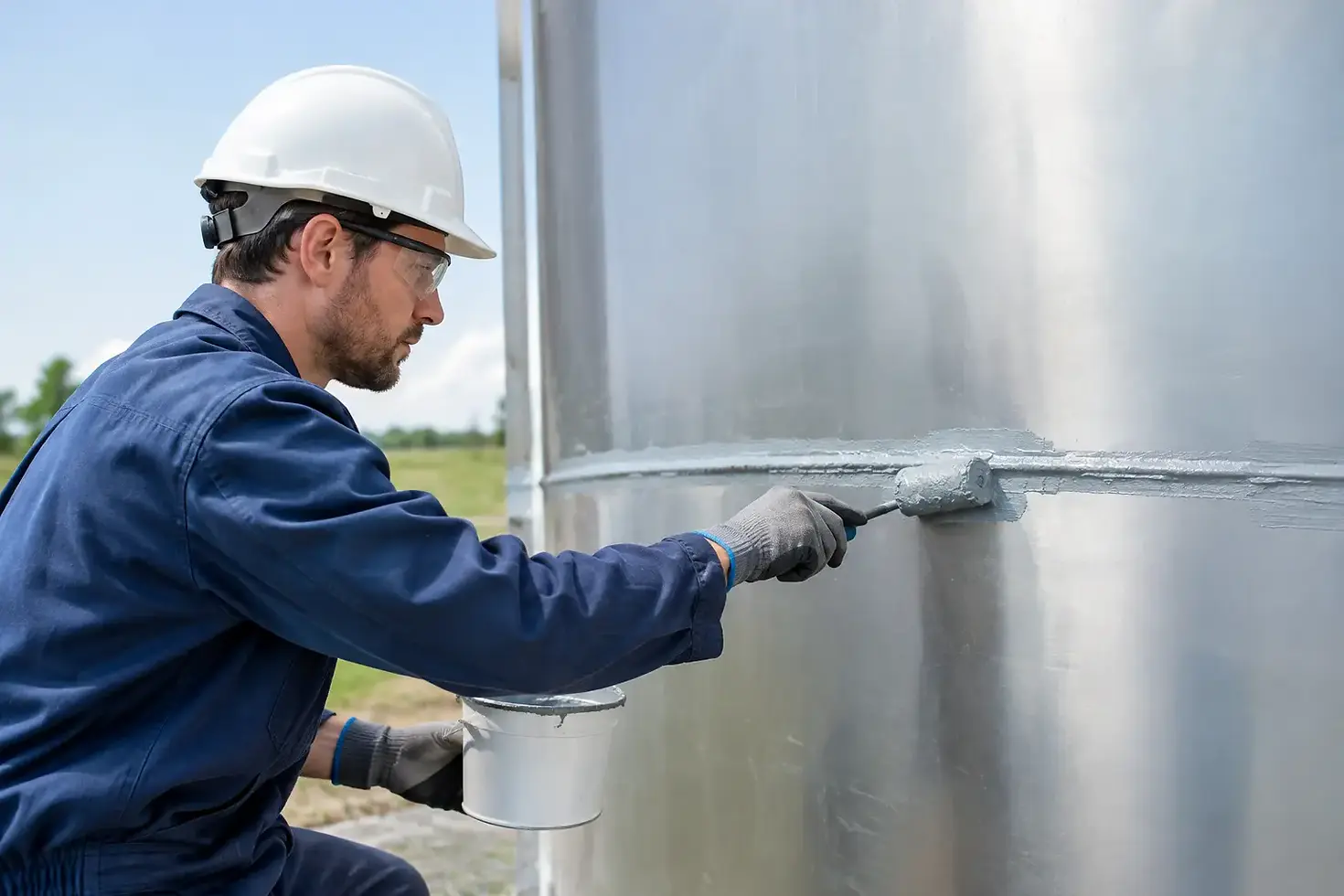
Where a leak is proven to arise from an otherwise sound external joint, it may be possible to clean and prepare the area before applying a compatible sealing system. This is generally a localised solution and is only suitable where panel corrosion is limited, the joint has not moved significantly and the original gasket arrangement remains serviceable.
Surface preparation is critical. Loose coating, corrosion products, failed sealant and contamination must be removed to create a sound substrate. Simply applying fresh sealant over aged mastic or rusted steel may stop a drip briefly, but it will not provide a dependable repair in a safety-critical tank.
External resealing can be a practical option when access is good and the defect is genuinely isolated. However, it should not be used as a substitute for investigating recurring leaks along multiple seams. Repeated local failures often point to a more systemic issue with joint gaskets, panel condition or structural movement.
Internal EPDM liner installation or repair
For many ageing sprinkler tanks, an internal EPDM lining system offers a more durable and commercially sensible route than dismantling the tank or replacing every deteriorated joint. The liner forms a continuous watertight barrier inside the tank, preventing stored water from reaching compromised seams and corroded internal surfaces.
This approach can be particularly effective where several seams are leaking, corrosion is present across the wetted area or historic repairs have become difficult to manage. It also reduces the reliance on every original panel gasket remaining watertight.
Lining is not a cure for an unstable tank. Before installation, the tank shell, floor, roof supports and connections must be assessed to confirm that the structure remains suitable. Damaged panels, severely corroded sections, failed bolts or roof loads may require separate remedial work. A lining system should be specified for the tank geometry, penetrations, internal fittings and duty conditions, then installed with proper detailing around flanges, pipework and corners.
Epoxy coating for suitable steel surfaces
An epoxy coating system may be considered where the tank is structurally sound, corrosion is manageable and the objective is to protect prepared steel surfaces. It can provide a durable barrier when specified and applied correctly, but successful coating work depends heavily on substrate preparation, environmental conditions and access.
Coating is not always the best answer for moving or poorly sealed sectional joints. If there is ongoing movement at a seam, a rigid coating can crack or lose adhesion. In these circumstances, a flexible lining system or joint-specific repair may provide better long-term performance.
Panel, bolt and gasket replacement
Where a seam failure is caused by physical damage, severe corrosion or loss of joint compression, the affected components may need replacement. This can involve renewing panels, bolts, gaskets and associated fixings, with the work sequenced to maintain structural stability.
This is more intrusive than resealing or lining and may require the tank to be drained or its water level reduced. It is nevertheless the correct route where the shell itself is no longer capable of providing a reliable supporting structure. A specialist contractor should assess temporary works, safe access and the implications for the sprinkler water supply before work begins.
Control the immediate risk before repair
A leaking sprinkler tank should be reported and assessed promptly. The operational team, responsible person and fire protection provider need a clear understanding of the tank’s condition and whether the leak affects the available water volume or the system’s ability to meet its design duty.
Temporary measures can sometimes manage a small leak while a permanent repair is planned, but they must not create false reassurance. Catchment arrangements, monitoring and controlled top-up may limit water loss, yet they do not address progressive corrosion or structural deterioration. They should be treated as short-term risk controls, agreed through the site’s impairment process.
Where the defect is significant, escalating, associated with panel distortion or close to a critical connection, urgent specialist advice is required. Unplanned loss of water can affect business continuity as well as fire safety. Early intervention usually creates more repair options and avoids the higher cost of emergency replacement.
Plan the work around sprinkler availability
The practical challenge in tank seam repair is often not the repair itself but maintaining protection while it is carried out. Some work can be completed externally with the tank in service. Internal lining, coating and panel replacement usually require isolation, draining or controlled reduction of water levels.
Before starting, establish the necessary impairment plan. This should define who is notified, what temporary fire precautions are required, how long the tank will be unavailable and how the sprinkler system will be returned to service and verified. Insurers may require notification, particularly where the building has high fire loading, valuable stock or limited alternative protection.
Access also matters. Roof condition, access housing, internal ladders, confined-space controls and lifting arrangements must be considered. A corroded tank roof or damaged purlin should not be treated as a separate cosmetic issue if operatives need to work around it. Safe, planned access is part of delivering a reliable repair.
Check the repair after completion
A seam repair should be inspected as a system, not only at the original leak point. Once the tank is refilled or returned to its normal operating level, the repaired area and adjacent seams should be monitored for signs of leakage, movement or coating and liner defects.
Records should include the survey findings, repair specification, materials used, photographs, test results and any recommendations for future inspection. This evidence supports maintenance planning, provides reassurance to insurers and helps demonstrate that the fire water asset is being managed responsibly.
Nationwide Water Solutions Ltd approaches seam failures as part of the wider condition of the sprinkler tank. Where targeted repairs are appropriate, they can preserve service life at sensible cost. Where lining, coating, structural remediation or replacement is needed, identifying that early gives building operators the time to make a controlled, compliant decision rather than responding to a preventable emergency.
A tank seam that begins as a minor drip deserves proportionate attention. Arrange a specialist assessment while the repair choices are still broad, and the site can retain control of cost, programme and fire protection continuity.


Comments