.png)
ROV Inspection vs Manual Inspection
Updated: Jul 27

When a sprinkler tank needs assessing, the real question is rarely whether an inspection is required. It is whether the tank can be inspected without creating unnecessary risk, cost or operational disruption. That is where ROV inspection vs manual inspection becomes a practical decision for property owners, facilities managers and fire protection stakeholders responsible for keeping critical water storage assets compliant and available.
For many sites, the traditional approach has been to isolate the tank, drain it down, arrange access, and send personnel inside to carry out a close visual inspection. That method still has a place. However, it also brings obvious drawbacks - loss of stored fire water, confined space working, programme delays and the added cost of refilling, cleaning and reinstatement. Remote operated vehicle inspection offers a different route, particularly where the priority is to inspect the asset while keeping the tank in service.
ROV inspection vs manual inspection for sprinkler tanks
In sprinkler tank environments, an ROV inspection uses a submersible remotely operated vehicle fitted with cameras and lighting to inspect internal conditions while the tank remains full of water. The vehicle is controlled from outside the tank and captures footage of internal surfaces, joints, liners, roof structures and visible defects.
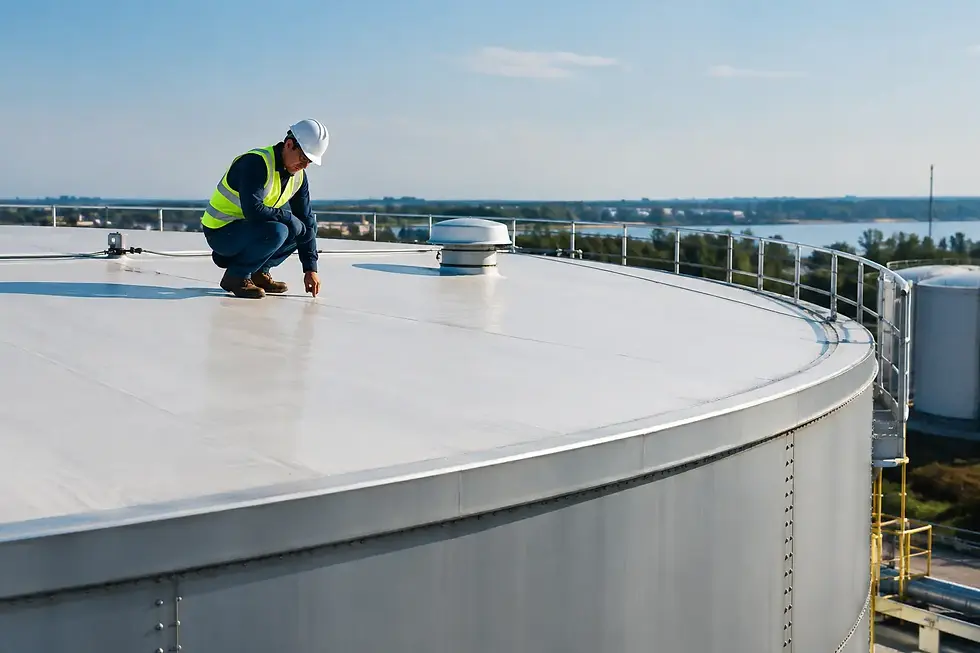
Manual inspection is more direct. It generally involves draining the tank, making it safe for entry, and sending trained personnel inside to inspect the structure and any internal components at close range. Depending on the scope, this may include physical probing, thickness assessment, cleaning, minor intrusive checks or preparation for repair works.
On paper, the comparison can look simple - one is remote, one is hands-on. In practice, the choice depends on what information is needed, what condition the tank is believed to be in, and how much operational interruption the site can tolerate.
Where ROV inspection has a clear advantage
The strongest case for ROV inspection is where maintaining water availability matters. On many commercial and industrial sites, taking a sprinkler tank offline is not a minor inconvenience. It can affect insurer requirements, fire strategy, site operations and business continuity. If the tank can remain in service while still being visually assessed, that is often the most commercially sensible first step.
ROV inspection also reduces the need for confined space entry at the initial survey stage. In a safety-critical sector, that matters. Fewer people exposed to avoidable risk is a sound engineering principle, especially when the first objective is to establish the general internal condition of the tank rather than immediately carry out intervention works.
There are cost advantages as well. A no-drain inspection avoids the labour, time and practical complications involved in draining large water volumes, managing temporary arrangements and refilling the asset afterwards. For older tanks that may already be showing signs of deterioration, reducing handling and disturbance can also be beneficial until a defined repair strategy is agreed.
For this reason, ROV surveys are particularly useful where clients need an informed condition report before committing to refurbishment, relining or replacement. They can identify visible corrosion, failed coatings, torn liners, sediment build-up, damaged joints and other defects without forcing an immediate shutdown.
Where manual inspection still matters
ROV inspection is not a replacement for every type of tank inspection. Manual inspection remains important where close physical examination is necessary or where repair planning depends on details that cameras alone cannot fully confirm.
If a tank has advanced structural deterioration, significant deformation, severe corrosion around fixings, or concerns about inaccessible areas, a drained internal entry inspection may still be the right option. The same applies where the scope requires direct measurement, substrate preparation assessment, material sampling or physical verification before major remedial works.
Manual access can also be necessary when the objective goes beyond inspection and into execution. If internal cleaning, steelwork treatment, sectional replacement, roof repairs, coating works or lining installation are required, the tank will often need to be taken out of service as part of the planned works package.
That is why the sensible comparison is not about declaring one method better in every case. It is about sequencing. In many projects, ROV inspection is the best diagnostic starting point, while manual inspection follows later if the findings justify a deeper intervention.
Cost is not just the inspection fee
One of the most common mistakes in comparing ROV inspection vs manual inspection is looking only at the day rate for the survey itself. For asset owners and responsible persons, the real cost sits in the wider operational impact.
A manual inspection may appear straightforward until the associated requirements are added in. Draining the tank, isolating systems, arranging safe entry procedures, coordinating confined space controls, cleaning, potentially providing temporary fire protection measures, and then refilling and recommissioning all carry cost. On some sites, those indirect costs exceed the inspection fee by a considerable margin.
ROV inspection often compares favourably because it limits that disruption. It can provide a meaningful view of internal condition without affecting water storage resilience in the same way. That does not mean it is always the cheapest route overall. If a tank is already scheduled for shutdown and internal works, a manual inspection may be more efficient as part of the same programme. Context matters.
Compliance, reporting and insurer confidence
For sprinkler tanks, inspection is not just about maintenance planning. It is also about demonstrating responsible asset management in a compliance-led environment. Building operators, insurers and fire risk stakeholders need confidence that water storage assets are being assessed properly and that defects are being identified before they compromise system performance.
A professionally delivered ROV inspection can support that objective well, particularly when the survey includes clear imagery, defect identification and practical engineering recommendations. It provides documented evidence of condition and can help clients justify next steps, whether that means continued monitoring, targeted repairs or a wider refurbishment scheme.
Manual inspection may provide a more detailed evidential base where defects are severe or where specification decisions depend on direct internal access. In those situations, the additional disruption can be justified because the inspection outcome needs to support a substantial remedial project.
The key point is that compliance is not strengthened by choosing the most disruptive method. It is strengthened by choosing the appropriate method and acting on the findings.
Choosing the right method for the tank condition
If a tank is operational, the site cannot easily absorb downtime, and the goal is to understand current internal condition, ROV inspection is usually the stronger first option. It gives decision-makers evidence without immediately creating a larger operational problem.
If the tank is already known to have serious defects, is due for internal works, or requires physical verification before refurbishment, manual inspection may be the more appropriate route. The same is true where visual access alone will not answer the engineering question.
Age also plays a part. Older galvanised steel or sectional GRP tanks may present a combination of coating breakdown, corrosion, liner failure or roof deterioration. In many of these cases, an ROV survey helps establish whether refurbishment is viable before anyone moves too quickly towards replacement. That is often where specialist contractors add most value - by identifying what can be repaired safely and economically rather than assuming the whole asset is beyond recovery.
Nationwide Water Solutions Ltd works in exactly that space, where inspection is not treated as an isolated service but as the first stage in protecting the life of a critical fire water asset.
The better question is what decision the inspection needs to support
Too often, inspection methods are discussed as though they are competing products. They are not. They are tools used to answer different engineering questions.
If the decision is whether the tank appears serviceable and what defects are visible without draining it, ROV inspection is often the most practical and least disruptive answer. If the decision is how to execute a major internal repair, what substrate condition exists beneath a failed system, or whether structural components require direct intervention, manual inspection may be necessary.
That distinction matters because it keeps the process proportionate. Sites responsible for fire water storage do not need more disruption than the situation demands. They need accurate condition data, sensible risk control and a clear route from inspection to remediation if problems are found.
The strongest inspection strategy is usually the one that preserves fire protection resilience for as long as possible while still giving you enough technical certainty to act with confidence. If an ROV survey can provide that certainty, it is often the right place to start. If it cannot, a planned manual inspection should follow for the right reasons, not simply because that is how it has always been done.
For most responsible asset owners, that is the practical standard to apply: choose the method that gives you the information you need, with the least avoidable risk to people, operations and fire protection availability.


Comments