.png)
Sprinkler Tank Inspection: What Matters
Updated: May 6

A sprinkler tank rarely fails without warning. More often, the warning signs are there for months or years - hidden corrosion below the waterline, a roof structure starting to deteriorate, joints under strain, a liner losing integrity, or sediment building up where no one can see it. That is why sprinkler tank inspection is not a box-ticking exercise. It is a practical control measure that protects fire system reliability, supports compliance, and helps asset owners avoid unnecessary replacement costs.
For property owners, facilities managers and responsible persons, the difficulty is not understanding that inspection matters. The difficulty is knowing what a meaningful inspection looks like, how often it should be carried out, and what to do when defects are found. In a safety-critical environment, vague reports and generic observations are not enough. You need a clear view of tank condition, risk level and the most commercially sensible next step.
Why sprinkler tank inspection matters
A fire water storage tank can appear serviceable from the outside while serious issues develop internally. Corrosion can advance behind coatings. Roof members can deteriorate in areas that are not routinely visible. Sectional joints can begin to leak. EPDM liners and other lining systems can suffer wear, movement or localised failure. If these issues are missed, the result is not just a maintenance problem. It can affect available water supply, insurer confidence and overall fire protection resilience.
Inspection also has a direct financial value. Early intervention often makes refurbishment viable where delay pushes the asset closer to major structural work or full replacement. A targeted repair, reline or roof refurbishment is usually far more manageable than an emergency response to a leaking or compromised tank. In operational terms, the earlier a defect is identified, the more options remain available.
There is also the issue of business continuity. Many sites cannot tolerate prolonged impairment of their sprinkler water storage. Warehousing, manufacturing, public sector buildings and large commercial premises frequently depend on uninterrupted protection. Inspection, especially where no-drain methods are appropriate, gives stakeholders a way to understand condition without creating avoidable disruption.
What a proper sprinkler tank inspection should assess
A useful inspection does more than confirm that a tank exists and contains water. It should assess the tank as an engineered asset with multiple failure points and serviceability risks.
The structure itself is central. Inspectors should look at panel condition, joint integrity, signs of deformation, fixings, support arrangements and any evidence of leakage or movement. For galvanised steel and sectional GRP tanks, different materials present different deterioration patterns, so the inspection should reflect the construction type rather than applying a one-size-fits-all checklist.
Internal condition is equally important. Corrosion, coating breakdown, liner performance, scale, biological growth and sediment accumulation all affect long-term reliability. A heavy sediment load may not mean immediate failure, but it can indicate poor internal condition and complicate future maintenance. Likewise, a small defect in a liner may look minor in isolation yet point to broader movement, wear or poor substrate condition.
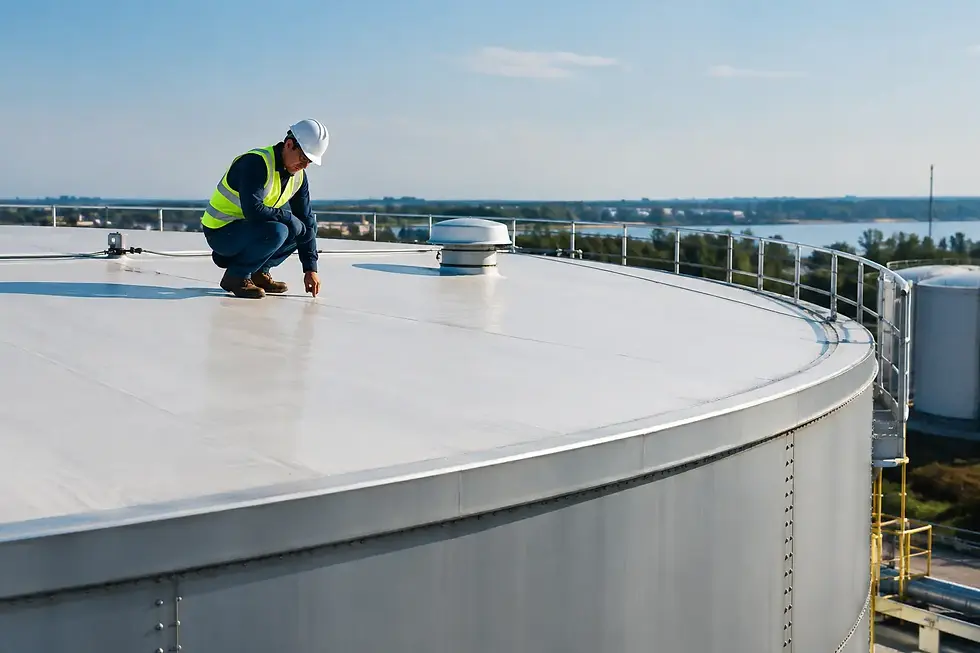
The roof deserves close attention because it is often overlooked until there is obvious failure. Damaged covers, degraded purlins, water ingress and weakened roof components can all undermine the tank over time. If roof issues are left unresolved, internal deterioration often accelerates.
Access and ancillary components should also be reviewed. Low level access housing, ladders, hatches, vents, overflow arrangements and warning systems all affect safe use, maintenance access and regulatory confidence. An inspection report should not treat these as secondary details if they create operational or safety concerns.
The value of no-drain and ROV inspection
One of the main reasons inspections get delayed is the perceived disruption of taking a tank out of service. On many sites, draining a sprinkler tank is not straightforward. It can require planning around system impairment, temporary measures, cleaning logistics and downtime that the building operator would rather avoid.
That is where no-drain inspection methods can be especially valuable. ROV inspection allows internal condition to be assessed while the tank remains in service, which is a major advantage for occupied and operational premises. It reduces disruption, avoids unnecessary loss of stored water and provides visual evidence from areas that would otherwise remain difficult to assess.
That said, it depends on the objective. An ROV survey is highly effective for condition assessment, identifying defects and supporting maintenance planning, but some findings may still lead to a recommendation for drained access if physical repair, cleaning or intrusive investigation is required. The practical benefit is that you only move to that stage when there is a defined reason, rather than draining first and asking questions later.
Common findings and what they usually mean
Not every defect demands wholesale replacement. In fact, one of the most common problems in this sector is the assumption that ageing automatically means end of life. A competent inspection often shows otherwise.
Corrosion is a typical example. Localised corrosion may be suitable for remedial treatment, coating repair or relining, depending on severity and substrate condition. Leaks at joints may point to deterioration that can be addressed through sectional repair or refurbishment rather than full tank renewal. Roof defects are often repairable through targeted replacement of purlins, covers or associated components.
Liner issues also need careful interpretation. A failed or ageing liner does not always mean the tank body itself is beyond economical repair. In many cases, reline work can restore serviceability and significantly extend asset life. The key is understanding whether the underlying structure remains suitable.
There are, of course, cases where replacement is the right answer. Severe structural degradation, widespread failure across multiple components, or a tank that no longer meets the site's operational needs may justify a new installation. The point of inspection is to reach that conclusion on evidence, not assumption.
Compliance, standards and insurer expectations
In the UK, sprinkler water storage is not just a maintenance issue. It sits within a wider compliance framework shaped by fire protection standards, insurer requirements and duty of care responsibilities. Inspection records demonstrate that the tank has been assessed, that known defects have been reviewed, and that asset owners are taking reasonable steps to maintain reliable fire protection infrastructure.
For many organisations, insurer scrutiny is a significant factor. If a tank has visible defects, a history of leakage or no recent evidence of technical assessment, that can raise questions during renewal discussions or after a loss event. A clear inspection trail, supported by technical recommendations and remedial planning, helps reduce uncertainty.
It is also worth recognising that compliance is not only about passing an audit. A tank can look acceptable on paper while hidden defects continue to worsen. The most useful inspection approach combines standard-driven reporting with real engineering judgement.
When to arrange an inspection
There is no benefit in waiting until water loss, contamination or visible external failure forces the issue. Inspection should be planned as part of routine asset management, with additional surveys triggered by specific risk indicators.
Older tanks should be monitored more closely, particularly where original materials, coatings or liners are reaching the end of their expected service life. The same applies where there is a history of leaks, known corrosion, roof deterioration or previous patch repairs. Changes in insurer requirements, property acquisition, major refurbishment works or unexplained performance concerns are also sensible points to commission an inspection.
If the site has limited maintenance history, that alone is reason enough to establish a clear baseline. A technical survey gives decision-makers something they often lack - evidence.
What to expect from the inspection outcome
The real value of a sprinkler tank inspection is what happens after the survey. A useful report should define observed defects, explain their significance, and separate urgent issues from manageable deterioration. It should also make practical recommendations.
That may mean no immediate action beyond monitoring. It may mean programmed refurbishment to extend service life. It may identify the need for relining, roof replacement, fibreglass repairs, coating works or localised sectional remediation. In some cases, it will support a replacement strategy. What matters is that the outcome is proportionate to the condition found.
This is where specialist contractors add value. Technical inspection should lead to workable solutions, not generic advice that leaves the client to interpret the risk alone. Companies such as Nationwide Water Solutions Ltd operate in this space because fire water tanks are not general maintenance assets. They require specialist surveying, repair knowledge and an understanding of how to keep protection systems dependable while controlling cost.
A well-timed inspection gives you options. It allows you to repair before failure, budget before emergency spend, and make decisions based on condition rather than worst-case assumption. For any organisation responsible for fire water storage, that is not simply good maintenance practice. It is a sensible way to protect both compliance and continuity.


Comments