.png)
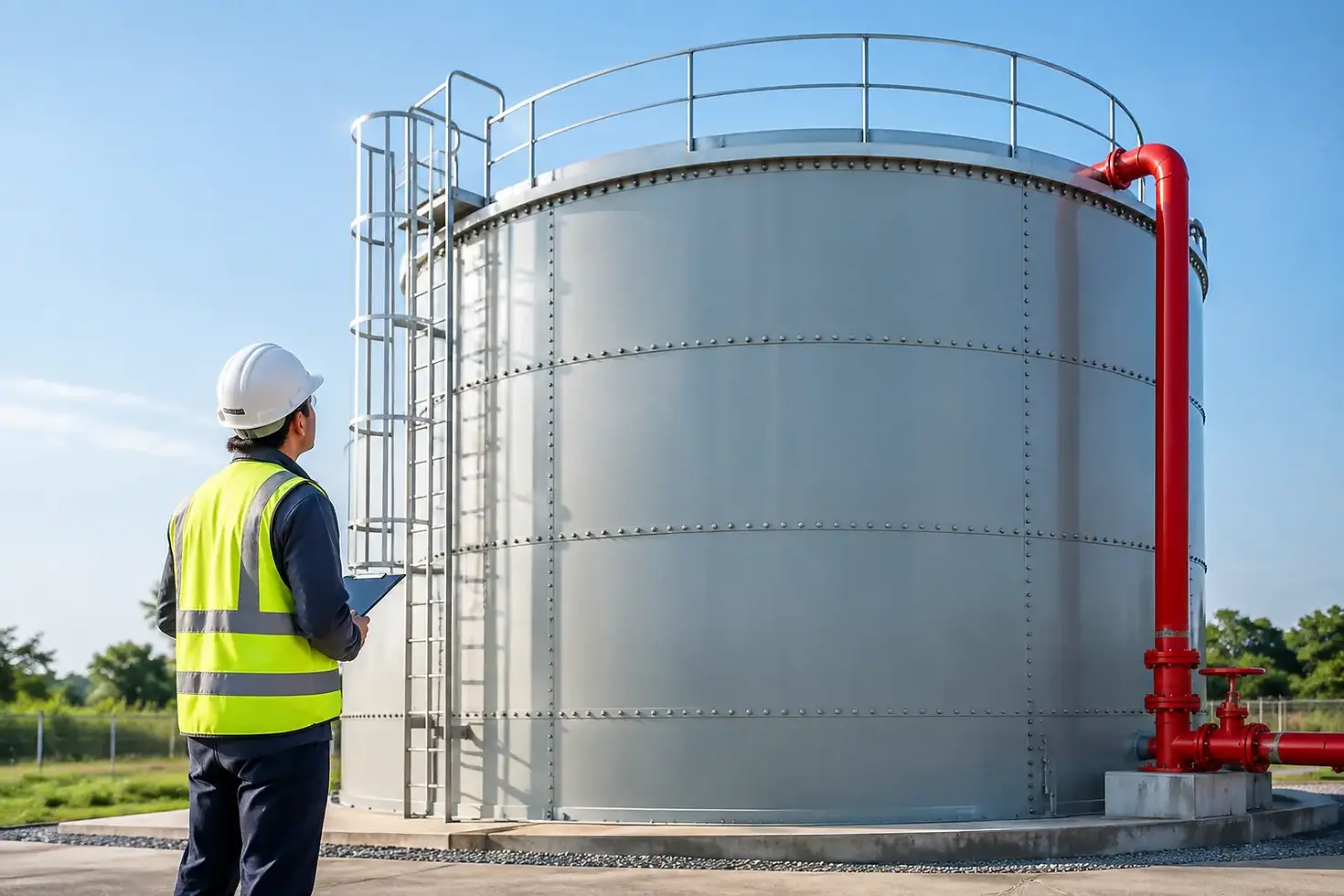
Tank Restoration for Reliable Fire Water Storage
A sprinkler tank can appear serviceable from the outside while deterioration continues below the waterline, behind roof cladding or within inaccessible joints. Tank restoration provides a controlled way to address those defects before they compromise the water supply relied upon by a fire protection system. For property owners and duty holders, the objective is not simply to improve appearance. It is to preserve a dependable, compliant source of fire water without committing to replacement where technically sound refurbishment remains the better option.
When a sprinkler tank needs attention
Fire water tanks operate in demanding conditions. Constant water exposure, condensation, changing temperatures and ageing protective finishes can all affect the tank structure and its internal environment. Galvanised steel tanks may develop corrosion at seams, bolt heads, base connections and roof-level components. GRP tanks can suffer cracking, distortion, damaged panels or deteriorating seals. Failed liners may allow water to reach the structure beneath, while roof defects can introduce contaminants and accelerate internal deterioration.
Leaks are an obvious warning sign, but they are not the only reason to investigate. Discoloured water, recurring low-water alarms, visible corrosion, damaged insulation, roof movement, failed sealant or a history of temporary repairs all warrant specialist assessment. In many cases, the issue is found during a routine inspection or after an insurer requests evidence of tank condition and maintenance planning.
The consequence of delay can be disproportionate. A minor lining failure may become a structural corrosion problem; a local roof defect can develop into widespread water ingress. More significantly, a tank that cannot provide its required volume or remains out of service for repair may leave a site with reduced fire protection resilience. That creates operational, compliance and insurance concerns that should be managed well before an emergency occurs.
Tank restoration starts with the right survey
The correct repair depends on the condition of the tank, its construction, its location and the requirements of the sprinkler installation. A solution should not be prescribed from photographs alone. A competent survey considers the shell, base, roof, liner or coating, joints, access arrangements, internal fittings and the surrounding supporting structure.
Where draining the tank would create disruption or affect sprinkler availability, a remotely operated vehicle inspection can provide valuable information without taking the tank out of service. An ROV can inspect submerged areas, identify debris, corrosion, lining damage and internal obstructions, and produce footage to support repair decisions. This is particularly useful where access is restricted or where there is uncertainty about the extent of deterioration below the waterline.
A survey should also establish whether the defect is localised or systemic. Local damage may be resolved through targeted fibreglass repair, sealing work or replacement components. More extensive corrosion, failed internal protection or widespread roof deterioration may require a planned refurbishment programme. The distinction matters because a repair that only treats the visible symptom can result in repeat disruption and unnecessary cost.
Assessing the repair-versus-replacement decision
Full replacement is sometimes necessary, particularly where structural integrity has been materially compromised or the tank no longer meets the required capacity or configuration. However, replacement is not automatically the safest or most economical answer. It can involve extended programme times, substantial site work, changes to pipework and control arrangements, and careful management of temporary water provision.
Restoration is often commercially sensible where the primary structure remains viable. Relining, coating renewal, roof replacement and targeted structural repairs can extend operational life at a lower capital cost than a new installation. The decision should be based on a documented technical assessment, expected service life, future maintenance requirements and the site’s tolerance for downtime, rather than on age alone.
Engineering measures used in tank restoration
A restoration project should be designed around the failure mechanism, not a generic menu of services. The following measures are commonly combined to return a sprinkler tank to reliable condition.
EPDM tank relining
EPDM lining systems provide a durable internal barrier between stored water and the tank structure. They are particularly valuable where an existing liner has failed, corrosion is developing internally, or the client needs to extend the service life of a steel or sectional tank. A properly specified and installed lining can protect the substrate, help prevent leaks and reduce the risk of further internal degradation.
Preparation is critical. The tank must be cleaned, defects addressed and surfaces made suitable before lining work begins. Details around corners, penetrations, flanges and internal fittings require particular care, as these are common locations for water ingress when workmanship is poor. The chosen system should be appropriate for the tank geometry and operating conditions, with installation backed by clear quality controls and a meaningful guarantee.
Coatings and fibreglass repairs
Epoxy coating systems can be an effective option where surface protection is required and the substrate is suitable for coating preparation. They may be used to address corrosion and preserve exposed steel elements, subject to correct surface treatment and environmental conditions during application. Coatings are not a substitute for structural repair, and they should not be applied over active corrosion or defective surfaces simply to improve appearance.
For GRP tanks, fibreglass repairs can restore damaged panels, roofs and local structural areas. Cracks, impact damage and defects around joints must be assessed carefully to determine whether a repair will provide lasting performance. Where damage is extensive or panel deterioration is widespread, sectional replacement may offer a more reliable outcome than repeated patching.
Roof, purlin and access improvements
The roof is often overlooked until water ingress, distortion or safety concerns become apparent. Damaged roof sheets, deteriorated purlins and failed fixings can affect tank cleanliness, insulation performance and structural protection. Roof and purlin replacement can form a central part of refurbishment, particularly on older tanks exposed to weathering or condensation.
Access arrangements should be reviewed at the same time. Low-level access housing and properly planned entry points can improve the safety and efficiency of future inspection and maintenance. Better access does not eliminate the need for confined-space controls, but it can reduce avoidable disruption and make condition monitoring more practical over the tank’s remaining life.
Managing sprinkler protection during the works
A technically sound refurbishment can still create risk if the works are poorly planned. Taking a sprinkler tank out of service affects a critical life-safety asset, so the programme must be coordinated with the responsible person, fire protection contractor, insurer and, where relevant, the local fire and rescue service.
The level of impairment planning required depends on the site and system arrangement. Some facilities have duplicate supplies or alternative water provision; others have limited resilience and may need work sequenced around operational constraints. Controls can include enhanced fire watches, restrictions on hot works, temporary detection measures, clear notification procedures and a defined process for returning the system to service. The right approach is site-specific, but it should always be agreed before work begins rather than improvised during it.
Quality assurance is equally important at completion. Repairs, linings, coatings and replacement components should be inspected and recorded, with defects resolved before handover. Clear documentation supports ongoing maintenance, assists with insurer discussions and gives facilities teams an accurate baseline for future inspections.
Planning restoration before failure occurs
The most cost-effective tank projects are usually planned before leakage, severe corrosion or insurer intervention forces an urgent response. Regular visual checks, periodic specialist inspections and prompt investigation of changes in water level or condition allow defects to be addressed while options remain open.
For multi-site operators, a condition-based programme can prioritise tanks by risk, age, construction, known defects and operational importance. This makes capital expenditure more predictable and avoids treating every ageing asset as an immediate replacement project. It also helps demonstrate that fire water storage is being actively managed as part of the wider fire safety strategy.
Nationwide Water Solutions Ltd approaches tank restoration as an engineering decision: identify the true condition, select the proportionate remedy and protect the sprinkler water supply throughout the process. A timely survey can turn an uncertain tank into a manageable refurbishment plan, preserving the asset and giving those responsible for the building greater confidence when it matters.


Comments