.png)
Low-Level Access Housings for Sprinkler Tanks
A sprinkler tank may only need attention periodically, but the route into it must be safe every time. The role of low-level access housings in improving safe access to sprinkler tanks is therefore far more significant than a simple entrance detail. A properly designed housing protects the access point, gives maintenance teams a controlled working area and helps sites carry out inspection and repair work without introducing avoidable risks to a critical fire water asset.
For facilities managers, insurers and responsible persons, access arrangements can influence both the quality of maintenance and the practical ability to respond when a defect is identified. Where a tank entrance is exposed, poorly secured or difficult to reach, even straightforward works can become slower, more disruptive and less safe.
Why sprinkler tank access needs specialist attention
Sprinkler tanks are safety-critical installations. Their purpose is to provide a dependable water supply when it is needed most, often at industrial, commercial and public buildings where an interruption to fire protection creates serious operational and insurance concerns.
Yet many older tanks were installed with limited consideration for the frequency and type of future intervention. Low-level access points may be exposed to weather, located in congested plant areas or approached across uneven ground. The access opening itself may be difficult to secure, while the surrounding area offers little protection for personnel preparing to enter or inspect the tank.
This is not merely an inconvenience. Poor access can delay condition surveys, complicate liner repairs and increase the risks associated with confined-space entry. It can also leave a vulnerable point in the tank envelope exposed to water ingress, accidental damage and unauthorised access.
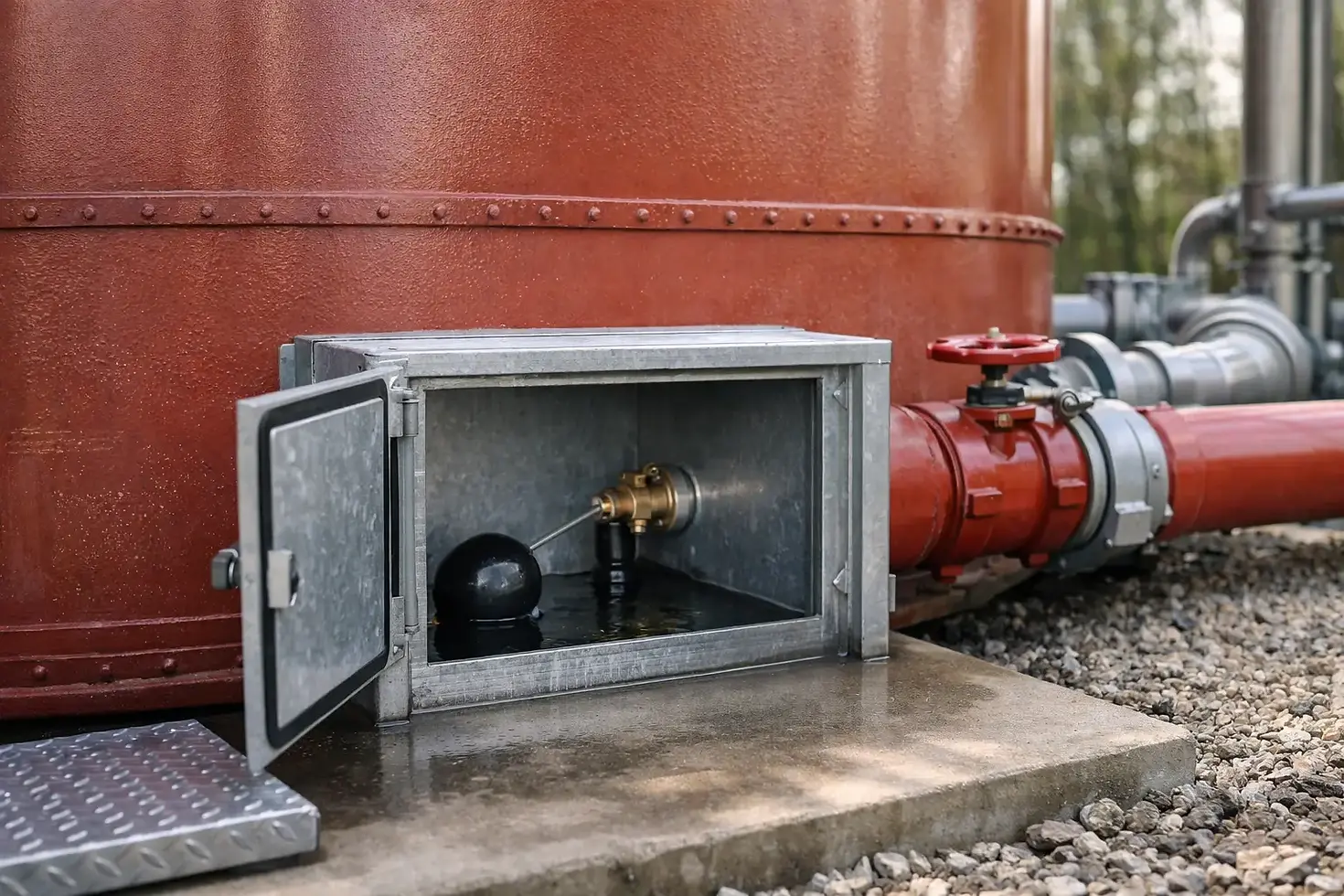
A low-level access housing addresses these issues by creating a purpose-built, protected enclosure around the tank's access point. The exact arrangement depends on the tank construction, site layout and maintenance requirements, but the objective remains consistent: safer, more controlled entry for trained specialists and more reliable protection of the tank opening.
How low-level access housings improve safe access to sprinkler tanks
A well-specified housing provides a sheltered space where operatives can prepare for work before entering the tank. This may include checking equipment, managing hoses or cabling, putting on appropriate protective equipment and establishing the controls required by the risk assessment and method statement.
The benefit is particularly clear during inspection, refurbishment and repair projects. Engineers often need to assess internal steelwork, tank linings, corrosion, seams, connections and localised damage. If access is exposed to rain, wind, standing water or site traffic, the work becomes more difficult to manage safely and efficiently.
The housing also helps keep the access point clean and protected between visits. Debris, surface water and vermin can create problems around an unprotected entrance. A secure enclosure reduces this exposure and supports better housekeeping around an asset that should remain ready for service.
For sites using remotely operated vehicle inspections, a low-level access housing can provide a more controlled location for introducing the ROV and managing associated equipment. This supports no-drain inspection methods, which can be a major advantage where taking the sprinkler tank out of service would affect fire protection availability or create substantial operational disruption.
Security and asset protection
Unauthorised access to a sprinkler tank is an obvious concern. An access housing should be designed to discourage entry by unauthorised persons while still allowing authorised contractors and site teams to reach the access point without delay when planned work is required.
Security needs to be balanced with emergency procedures. Locking arrangements, access control and key management should be clear to the responsible site team. A housing that is secure but impractical to open during an urgent inspection does not provide the intended benefit.
The enclosure also gives physical protection to the low-level access door, hatch or manway. This is valuable in busy environments such as warehouses, manufacturing facilities and distribution centres, where vehicle movements, stored materials and general site activity can create a risk of impact damage.
A better environment for inspection and repair
Tank condition is not always visible from the outside. Corrosion beneath a lining, damaged internal components, leakage paths and deterioration at joints can develop gradually. Early intervention is generally less disruptive and more economical than allowing the issue to progress to a point where extensive refurbishment or replacement is necessary.
Reliable access makes planned inspection more achievable. It gives specialist contractors a practical route to carry out internal assessment, undertake repairs or install refurbishment systems with the correct controls in place. This can include EPDM liner work, epoxy coating repairs, fibreglass remediation or targeted repairs to tank components.
The housing does not remove the need for safe systems of work. Tank entry can involve confined-space hazards, and each project requires suitable planning, trained personnel, atmospheric monitoring where applicable, rescue arrangements and task-specific controls. What the housing does provide is a more suitable starting point for those measures.
Design considerations before installation
Low-level access housings should not be treated as standard off-the-shelf additions. The correct design depends on the tank type, the position and size of the access opening, available space, ground conditions and the work expected to be undertaken over the tank's remaining service life.
For example, a housing serving a sectional steel sprinkler tank may need to accommodate the geometry of an existing manway and the clearance required for liner installation or internal repair equipment. A GRP tank may present different interface and weatherproofing requirements. The route to the housing also matters. Engineers need sufficient room to move equipment safely, and the area should not obstruct emergency routes, drainage arrangements or normal site operations.
Weather resistance is another practical consideration. The housing should protect the access area without creating a damp, poorly ventilated enclosure that could accelerate local deterioration. Its construction, seals, drainage details and connection to the tank need careful assessment to prevent water tracking towards the access opening.
The level of finish should reflect the site environment. A housing on a secure, lightly trafficked compound may require a different solution from one located beside loading activity or in a publicly accessible area. In higher-risk locations, impact protection, improved security and more durable external finishes may be justified.
Compliance, inspection and insurer confidence
There is no substitute for maintaining the sprinkler system and its water supply in accordance with the relevant design standard, insurer requirements and the site's fire safety arrangements. Access provisions are one part of that wider duty, but they can have a material effect on whether maintenance can be completed properly.
When an insurer, fire protection contractor or competent inspector raises concerns about tank condition, the response should consider access as well as the visible defect. A new lining, repaired roof or replacement purlin may restore part of the asset, but restricted access can continue to make future inspection difficult. Combining remedial work with an access improvement can be a sensible lifecycle decision.
Clear records are equally useful. Site teams should retain information on the housing installation, access controls, inspections and any work undertaken through the entrance. This supports future maintenance planning and gives stakeholders greater confidence that the tank is being managed as a critical element of the fire protection system.
When a housing is not the only answer
Low-level access housings are highly effective where the principal issue is safe, protected access to an existing tank entry point. They are not, however, a cure for every tank defect.
If the tank has widespread corrosion, significant leakage, structural distortion or a failed internal lining, the underlying condition must be investigated and addressed. Likewise, if the access opening itself is deteriorated, its frame, sealing arrangement or surrounding panels may need repair before a housing is installed.
In some cases, a no-drain ROV inspection is the right first step because it provides condition information without immediately affecting the water supply. In others, a detailed technical survey may identify a package of work that combines access improvements with relining, coating, roof refurbishment or sectional tank repairs. The appropriate route depends on the tank's condition, the site's operational constraints and the need to maintain fire protection continuity.
Planning an effective upgrade
The strongest outcomes come from assessing the whole tank system rather than treating the access housing in isolation. A specialist survey should establish the condition of the low-level opening, the surrounding tank structure, the access route and any restrictions that will affect future maintenance.
It should also consider how the proposed housing will support the tasks the site expects to carry out. Internal inspections, ROV deployment, liner repairs and emergency access can each require different clearances and working arrangements. Designing for the likely maintenance need avoids installing a housing that is secure but too restrictive for specialist work.
Nationwide Water Solutions Ltd approaches these projects as part of a wider sprinkler tank refurbishment and lifecycle strategy. Where repair is commercially and technically appropriate, improving access alongside targeted remediation can extend the useful life of the tank while reducing the disruption and capital cost associated with full replacement.
A sprinkler tank is only dependable when it can be inspected, maintained and repaired safely. Providing a secure, practical low-level access housing gives the people responsible for that work a safer route to protect the fire water supply long before an emergency tests it.


Comments